A Plant-Rich Diet & Reducing Greenhouse Gases

The grand shutdown has caused a 17 percent reduction in greenhouse gases, which is great. However, that means even this amazing life change still left us producing 83 percent as much greenhouse gases as in the past. Plus the predictions are that when this is over everything will bounce back to where it was before or worse as production tries to catch up with what was lost.
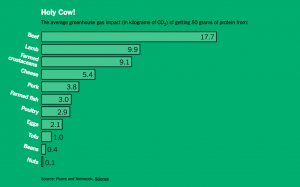
Graphic from New York Times

The other dilemma is that the Paris Accord says to prevent further warming, starting this year, we have to annually reduce our greenhouse gases by 7.6 percent. So if with everything stopped we got to only 17 percent, how will we get to 7.6 when everything starts up again? Using the Project Drawdown as our guide, there are actually several individual actions we can take — along with advocating for systemic changes. Some those actions will require changing behaviors to reach the 7.6 percent goal.

Perhaps the quickest personal fix for those of us who haven’t already done so is switching to a plant-rich diet. This is based on  Project Drawdown research :

Plant-rich diets hold enormous potential for climate change mitigation if adopted on a global scale…

Project Drawdown defines a plant-rich diet as the individual dietary choice: to 1) maintain a 2250 calorie per day nutritional regime; 2) meet daily protein requirements while decreasing meat consumption in favor of plant-based food items; and 3) purchase locally produced food when available…

Implementation of a plant-rich diet can be readily adopted even with small behavioral changes that can have a significant effect globally. In terms of cost, the solution appears to yield significant savings at the individual level, and indirectly at the national level through lower healthcare costs. Moreover, the burden of change seems highly equitable and implementable, because developing nations already consume fewer calories and do not need to shift their diets much, whereas developed nations need to address issues such as obesity.

The New York Times provides an excellent summary the effects diet has on climate change, including this:

Meat and dairy, particularly from cows, have an outsize impact, with livestock accounting for around 14.5 percent of the world’s greenhouse gases each year. That’s roughly the same amount as the emissions from all the cars, trucks, airplanes and ships combined in the world today.

In general, beef and lamb have the biggest climate footprint per gram of protein, while plant-based foods tend to have the smallest impact. Pork and chicken are somewhere in the middle.

Some choices in descending order to slow global warming are vegan (the best), vegetarian and finally flexitarian, which means mostly plant based with occasional servings of meat.

Here are the USDA figures for non-plant based consumption in the USA (these are figures adjusted for waste, which is another Drawdown item, we will deal with in later posts) :

the per capita supply of red meat, poultry, and fish/shellfish available for Americans to eat after adjusting for losses rose to 143.9 pounds in 2017. Red meat (beef, pork, veal, and lamb) accounted for 51 percent of 2017’s 143.9-pound total, compared with 42 percent for poultry (chicken and turkey) and 7 percent for fish and shellfish.

Using Project Drawdown a minimum step would be to cut that consumption to 45 pounds a year and of course the best course would be vegan and then vegetarian. This from a Project Drawdown report:

The adoption of a plant-rich diet assumes the following criteria are met:

  1. Adopting an individual daily nutritional regime of 2250 kilocalories per day;
  2. Consuming reduced quantities of meat-based protein (particularly red meat, which is constrained to 57 grams per day);[5] (That translates to about 2 ounces a day,  just under a pound a week  or about 45 pounds a year.)
  3. Purchasing locally produced food when possible (a 5 percent localization factor is applied globally).

Of course, along with the benefits to reducing global warming, eating a plant-based diet is healthier and it would remove the outsized risks — see here and here — that slaughterhouse and meatpackers face each day.

Posted in Actions, Climate News | Tagged , , , , , , , , | Comments Off on A Plant-Rich Diet & Reducing Greenhouse Gases

Covid-19: Greenhouse Gases Down 17%, But…

The Washington Post reports the Covid-19 world shut down led

to a startling decline of more than 1 billion tons of carbon dioxide emissions. That includes a peak drop in daily emissions of 17 percent in early April, according to the study, published in the journal Nature Climate Change.

Covid-19, no silver lining for climate change

That’s the good climate news, but experts think the emissions will quickly bounce back to former levels, plus there is this:

The unprecedented situation produced by the coronavirus has offered a glimpse at the massive cuts in global emissions, year after year, that would be required to meet the most ambitious goals set by world leaders when they forged the 2015 Paris climate accord. Last fall, a United Nations report estimated that global greenhouse gas emissions must begin falling by 7.6 percent each year beginning in 2020 to avoid the worst effects of climate change.

Also there are these two sobering insights into the difficulties in reaching Paris Accord standards:

The peak 17 percent decline in global emissions, which occurred in early April, still meant nations continued to generate more than 80 percent of the usual carbon pollution.

“We can see now that behavior change alone is not going to do it,” said Corinne Le Quéré, lead author of the study and director of Britain’s Tyndall Center for Climate Change Research.

And Zeke Hausfather, a scientist and director of climate and energy at the Breakthrough Institute, said:

“I don’t think there’s much of a silver lining to covid-19 for the climate,” he said, “unless we use the recovery as a chance to both stimulate the economy and build the type of infrastructure to support a clean-energy future.”

Photo credit: “File:Covid-19 Info (49674102678).jpg” by Eden, Janine and Jim from New York City is licensed under CC BY 2.0
Posted in Climate News | Tagged , , | Comments Off on Covid-19: Greenhouse Gases Down 17%, But…

Investor Prediction: Solar insanely, world-changingly cheap

Ramez Naam

Ramez Naam , author and solar investor, writes in part at his blog:

Solar has plunged in price faster than anyone – including me – predicted. And modeling of that price decline leads me to forecast that solar will continue to drop in price faster than I’ve previously expected, and will ultimately reach prices lower than virtually anyone expects. Prices that are, by any stretch of the measure, insanely, world-changingly cheap.

And why?

through learning-by-doing, a mixture of innovation that improves the technology itself and innovation that reduces the amount of labor, time, energy, and raw materials needed to produce the technology.

However, can that learning-by-doing translate to the other costs of getting electricity delivered to users. Naam thinks so, writing:

Every time the cumulative amount of solar we’ve deployed around the world has doubled, the price of electricity from utility-scale solar plants has dropped by a fairly consistent percentage.

Yet, even using his own optimistic projections, based the outsized performance of the past, he realizes:

Solar isn’t…a panacea. First, projections are only projections….

Second, the sun doesn’t always shine. To power evenings and night times, we’ll need to continue progress on cheap energy storage. And even more challenging is that solar peaks in the summer. In many regions, electricity demand peaks in the winter. In Germany, for instance, solar power output in December is just 1/5 of the solar power production in June, even as electricity demand is higher in winter than summer. Solar will need to be combined with other technologies such as wind power, hydro, long-term storage, and nuclear in order to have its greatest impact in decarbonizing society – particularly in areas with poor sun, long dark winters, or winter electricity peaks.

See the his complete blog post for more in-depth information.

Photo Credit: Sebastiaan ter Burg from Utrecht, The Netherlands / CC BY (https://creativecommons.org/licenses/by/2.0)
Posted in Climate News, Solar | Tagged , , , | Comments Off on Investor Prediction: Solar insanely, world-changingly cheap

NYTimes: Renewable Energy Poised to Eclipse Coal in U.S.

A New York Times article by 

The United States is on track to produce more electricity this year from renewable power than from coal for the first time on record.

Coal Fired Plants, Will They Disappear?

It adds:

It is a milestone that seemed all but unthinkable a decade ago, when coal was so dominant that it provided nearly half the nation’s electricity.Photo

It might not just be a blip caused by less driving and less use of electricity because of the pandemic.

“The grid is changing so much faster than anyone expected,” said Daniel Cohan, an associate professor of civil and environmental engineering at Rice University. “A decade ago, I was teaching my students that coal was the ‘baseload’ source that runs all the time, and solar was something you might sprinkle in if you want to pay more. Now coal’s been pushed to the margins and it’s wind and solar that are the cheapest options.”

Links to similar articles about the rise of renewables and fall of fossil fuels can be found here and here.

Photo credit: Arnold Paul, ShareAlike 2.5 Generic (CC BY-SA 2.5)
Posted in Climate News, Solar | Tagged , , , , | Comments Off on NYTimes: Renewable Energy Poised to Eclipse Coal in U.S.

What Does Drawdown Mean?

We are gradually working out way through the recently released Drawdown Review 2020. So it makes sense to talk about what Drawdown means and why it is the focus of  Project Drawdown.

This from the Drawdown Review 2020 (Pages 8-11):

First the Challenge:

Burning fossil fuels for electricity, mobility, and heat. Manufacturing cement and steel. Plowing soils. Clearing forests and degrading other ecosystems. All these activities emit heat-trapping carbon dioxide into the air. Cattle, rice fields, landfills, and fossil fuel operations release methane—a gas that warms the planet even more.

Nitrous oxide and fluorinated gases seep out of agricultural lands, industrial sites, refrigeration systems, and urban areas, adding still more heat-trapping pollutants to Earth’s atmosphere. Most of these greenhouse gases stay airborne, but not all. Natural biological and chemical processes—especially photosynthesis—bring some of that excess back to plants, soil, or sea. These “sinks” are nature’s reservoirs for absorbing and storing carbon.

To understand and advance climate solutions, it’s important to understand the sources of emissions and nature’s means of rebalancing the climate system.

Heat-trapping greenhouse gases come from six sectors:

▶ ~25% Electricity Production
▶ ~24% Food, Agriculture, & Land Use

▶ ~21% Industry
▶ ~14% Transportation
▶ ~6% Buildings

▶ ~10% Other Energy-Related Emissions

Here is complex solutions, stated rather succinctly:

Greenhouse gas sinks are the counterpoint to these sources. While ~59% of heat-trap- ping emissions stay in the atmosphere, ~24% are quickly removed by plants on land and ~17% are taken up by oceans.

To reach Drawdown, we must work on all aspects of the climate equation—stopping sources and supporting sinks, as well as helping society achieve broader transfor- mations. That is, three connected areas call for action, which we must pursue globally, simultaneously, and with determination.

So the three broad goals are:

1. Reduce Sources, bringing emissions to zero.

2. Support Sinks, uplifting nature’s carbon cycle.

3. Improve Society, fostering equality for all.

In subsequent posts we will start to look at some solutions, especially ones that might be relevant to a small town like Sandwich, NH or perhaps your town too. Of course, you don’t have to wait for us. You can read the report now. And if you need support, you can take free courses at the the Pachamama Alliance, which is helping to organize globally to reach drawdown.

Posted in Actions, Inspiration, Resources | Tagged , , , | Comments Off on What Does Drawdown Mean?

Drawdown Review for 2020 — Our Overview — Part I

One early inspiration for the Sandwich Climate Action Coalition was Project Drawdown and the 2017 book Drawdown. In March 2020, Project Drawdown released a 104-page Drawdown Review 2020, which updates the 2017 book to “respond nimbly to the rapidly evolving landscape of solutions and the urgency of the challenge humanity faces.”

The main mission stays the same:

 to help the world reach “Drawdown”— the future point in time when levels of greenhouse gases in the atmosphere stop climbing and start to steadily decline.

Our plan here, in making this blog a public file cabinet, is to read the entire report and  post to the blog as we find the most interesting bits of information.  We will start with the report’s ten overriding insights, which we will flesh out as we continue filing posts about this report:

1. We can reach Drawdown by mid-century if we scale the climate solutions already in hand. 

2. Climate solutions are interconnected as a system, and we need all of them.

3. Beyond addressing greenhouse gases, climate solutions can have “co-benefits” that contribute to a better, more equitable world.

4. The financial case for climate solutions is crystal clear, as savings significantly outweigh costs.

5. The majority of climate solutions reduce or replace the use of fossil fuels.We must accelerate these solutions, while actively stopping the use of coal, oil, and gas.

6. We cannot reach Drawdown without simultaneously reducing emissions toward zero and supporting nature’s carbon sinks.

7. Some of the most powerful climate solutions receive comparably little attention, reminding us to widen our lens.

8. Accelerators are critical to move solutions forward at the scale, speed, and scope required. 

9. Footholds of agency exist at every level, for all individuals and institutions to participate in advancing climate solutions.

10. Immense commitment, collaboration, and ingenuity will be necessary to depart the perilous path we are on and realize the path that’s possible. But the mission is clear: make possibility reality.

Posted in Actions, Climate News, Inspiration, Resources | Tagged , , | Comments Off on Drawdown Review for 2020 — Our Overview — Part I

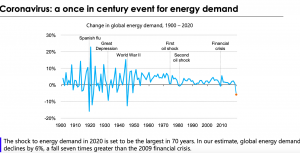
Covid-19 and the Future of Energy Use

Will the world wide decline in energy use, caused by the Covid-19 related economic slowdown, be a way to transition to clean energy or will the rebound be more use of fossil fuels?


Here is key summary paragraph from the implications section of Global Energy Review 2020 report produced by the International Energy Agency (IEA).


The Covid-19 and measures taken to slow its spread have had a profound impact on energy demand, the likes of which have not been seen for 70 years. The full impact of the current situation, as yet unknown, will be determined by the duration of lockdown measures and the recovery paths taken around the world. This unprecedented situation and the stimulus packages that governments are putting in place will shape the energy sector for years to come, with significant consequences for the energy industry at large, energy security and clean energy transitions.

There are clean energy opportunities here or will we go back to business as usual, the report contends:

The Covid‑19 crisis is also influencing the path for clean energy transitions. Global CO2 emissions are set for the largest year-to-year reduction on record, but a sustainable energy pathway calls for continuous efforts and commitment. The unprecedented decline in emissions in 2020 may only be temporary without structural changes. Recoveries from past crises have caused immediate rebounds in CO2 emissions, including the highest year-on-year increase on record in 2010.

Governments will play a big role:

Governments will play a major role in shaping the energy sector’s recovery from the Covid‑19 crisis, just as they have long been in the driving seat in orienting energy investment. In particular, the design of economic stimulus packages presents a major opportunity for governments to link economic recovery efforts with clean energy transitions – and steer the energy system onto a more sustainable path. While the clean energy transitions and stimulus discussions are gathering momentum, a co-ordinated policy effort will be needed to harvest its opportunities and lead to a more modern, cleaner and more resilient energy sector for all.

Posted in Actions, Climate News, Solar | Tagged , , | Comments Off on Covid-19 and the Future of Energy Use

Will Covid-19 Ruin Big Oil and Help Save the Climate?

Big Oil Is Under Stress

The prevailing narrative is that big bad oil and the fossil fuel industry will prevail no matter how bad a business model it might be. A Guardian  article weakens that assumption, by addressing: Will the coronavirus kill the oil industry and help save the climate?

Here is a key paragraph:

After the 2008 global financial crisis, there were high hopes that the trillions of dollars delivered at that time would green the economy, but fossil fuels and their emissions powered on, ever upwards. Kingsmill Bond, Energy Strategist for Carbon Tracker think tank, said: ‘The big difference to 2008 is that the cost of renewables is now below that of fossil fuels. There is no point trying to sustain the unsustainable high-cost fossil assets in any event’

Here is more:

Prof Bernard Haykel, at Princeton University, US, said it also reflects a more fundamental strategic shift led by Saudi Arabia’s crown prince, Mohammed bin Salman: “With a global clean-energy transition inevitable, he is desperate to cash out while the Kingdom still can.”

However, the transition from fossil fuel to clean renewables may need help:

Not all experts think the oil industry’s loss is necessarily a gain for green energy and the climate. “If anything it may hold up the share of oil for longer, because it’s cheaper. It could be bad news from a climate point of view,” said Dieter Helm, professor of energy policy at the University of Oxford.He said securing a green economic recovery from the coronavirus crisis will require deliberate policy measures from governments: “This is where the carbon tax comes in. Now is the moment.”

As we change the narrative not just about fossil fuels, there could also see changes in the way investors see the world:

The oil industry was already under pressure from investors concerned about the climate crisis and increasing regulation from governments to cut emissions. Colin Melvin, at Arkadiko Partners, a consultancy advising some of the world’s biggest investment management and pension funds, said that after the crisis he expects investment to flow increasingly towards companies perceived to offer wider social benefits.

“The purpose of the investment of capital in business is to create wellbeing, to create wealth in the true sense, and I think that is going to become more and more relevant to investors,” he said.

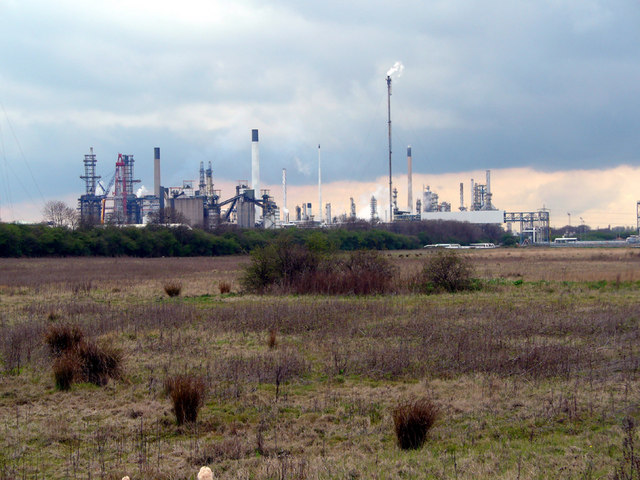
Photo credit: David Wright / Conoco Oil Refinery / CC BY-SA 2.0
Posted in Climate News, Solar | Tagged , | Comments Off on Will Covid-19 Ruin Big Oil and Help Save the Climate?

After Covid-19: VW Idea Could Advance Electric Vehicles

Financial Times reports VW:

The world’s largest carmaker wants EU governments to consider generous scrappage schemes, in which drivers are paid thousands of euros to swap their vehicles for newer models….

Markus Söder, the minister-president of Bavaria, which counts BMW and Audi among its carmakers, said such a programme would be a “huge opportunity” to drive the sales of electric vehicles.

Photo credit: Dietmar Rabich / Wikimedia Commons / “Dülmen, Kirchspiel, VW 1303 — 2017 — 2279” / CC BY-SA 4.0
Posted in Climate News | Comments Off on After Covid-19: VW Idea Could Advance Electric Vehicles

11 percent of NH’s 2018 Job Increase Was Clean Energy Related

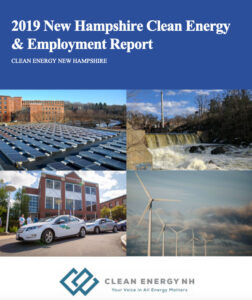
Of course, Covid-19 makes it hard to predict the future however this recently released 2019 Clean Energy New Hampshire report concludes:

2018 marked another year in the evolution of New Hampshire’s clean energy system. Despite the highest employment NH has seen in the past two decades, the Clean Energy and Energy Efficiency sectors outperform the NH economy as a whole, more than tripling the overall employment growth rate and adding 607 new jobs, representing more than 11 percent of the total 2018 state increase.


Posted in Climate News | Comments Off on 11 percent of NH’s 2018 Job Increase Was Clean Energy Related